About Me

Hi human or agent, nice to meet you!
I'm Yun-Yun (Alice) Tsai (蔡昀芸), a sixth year (final-year) Ph.D. in the Department of Computer Science at Columbia University, advised by Professor Junfeng Yang.
My research focuses on machine learning robustness in vision + language domain, test-time adaptation, LLM safety, and auto-evaluation for agentic systems. My goal is to design trustworthy and reliable foundation models and AI agent frameworks.
I received Bachelor's and Master's degrees in computer science, both from National Tsing Hua University (NTHU), Taiwan. Previously, I was advised by Professor Tsung-Yi Ho and Dr. Pin-Yu Chen from IBM Research Trusted AI group.
Misc:
- I am looking for strong motivated students for Research collaboration, working on broad AI security and agent auto-evaluation problems. I mentor both master and undergraduate students. If you know how to build fundamental AI algos or models, we should talk. Welcome to send me a human-written email to yt2781@columbia.edu.
- I am currently on the job market! I am looking for faculty positions in AI/ML track for next Fall, 2027, and also open to industry research scientist roles.
News
- [2025 May] Started research scientist intern at Meta SuperIntellience Labs @ Bellevue, WA.
- [2024 May] Started research scientist intern at Meta GenAI Team @ New York, NY.
- [2024 April] I passed my Ph.D. candidacy exam on April 24 2024. Thank to my committee members Prof. Richard Zemel, Prof. Carl Vondrick, and Prof. Junfeng Yang. (Slides)
- [2024 Feb] One main conf. paper + two workshop papers are accepted by CVPR 2024. See you in Seattle!
- [2023 Sep] One paper is accepted by NeurIPS 2023 @ New Orleans.
- [2023 May] Started applied scientist internship at Amazon Astro Team @ Bellevue Washington.
- [2023 Mar] Two papers are accepted by CVPR 2023 @ Vancouver.
What I Enjoy
Research
I work on Security in Artificial Intelligence: making machine learning algorithms and computer systems more trustworthy, secure, and robust — from adversarial robustness and test-time defenses to detecting AI-generated media.
To my papersMusic
I love music and have played the piano and viola for over 20 years. I was the 1st chair viola of Tsing Hua Symphony Orchestra for 4 years, and am a violist of the Columbia University Orchestra, performing at Lincoln Center's Alice Tully Hall.
Others
Snapshots beyond papers: internship experiences at Microsoft, visiting research at the University of Florida, conference travels, invited talks, volunteering, and team leadership.
To my photosProfessional Experience
§Research & Working Experience
-
 Meta SuperIntelligence Labs
Bellevue WA, USAResearch Scientist Intern · May. 2025 - Aug. 2025
Mentor: Sinong Wang, Yuning Mao, Shiqi Wang -
Meta GenAI Team
New York NY, USAResearch Scientist Intern · May. 2024 - Aug. 2024
Mentor: Laurens van der Maaten and Chuan Guo -
 Amazon Astro Team
Bellevue Washington, USAApplied Scientist Intern · Jun. 2023 - Sept. 2023
Mentor: Fu-Chen Chen and Prof. Sun Min -

Graduate Research Assistant · Sept. 2021 - present
Advisor: Prof. Junfeng Yang -

Graduate Research Assistant · Sept. 2018 – Jun. 2021
Advisors: Prof. Tsung-Yi Ho and Dr. Pin-Yu Chen -
Visiting Scholar · Mar. 2019 – Aug. 2019
Advisor: Prof. Yier Jin -
 Cloud and AI Engineering Group, Microsoft
Research Intern · Jul. 2017 – Jun. 2018
Mentors: Mrs. Cheryl Hsu and Mrs. Anne Yang
§ Honors, Awards, and Grants
- June 2024
- Awarded the 2024 CVPR's Travel Grant
- Nov. 2023
- Awarded the 2023 NeurIPS's scholar award
- June 2023
- Awarded the 2023 CVPR's scholar award
- Sep. 2021
- PhD Dean’s Fellowship, Fu Foundation School of Engineering and Applied Sciences, Columbia University.
- Aug.2020
- Best Presenter, Blackhat Award Forum in CyberSec, Taiwan, 2020.
§ Service
- Paper Review
- ICCV '25, CVPR '23 '24 '25, NeurIPS '23, IEEE Access, KDD '21, ICLR '21, AAAI '21
- Teaching Assistant
- Computer Vision II, Engineering Software-as-a-Service, Fundamental of Formal Language, Very-Large-Scale Integration
§ Invited Speech
- Dec.7.2025
- I was invited to give a talk at AI Governance course, taught by Professor Lake Dai, at Carnegie Mellon University Silicon Valley.
- Jan.7.2025
- I was invited to give a talk about"Exploring Safety of Machine Learning Models and Generative AI" at the Department of Electrical Engineering, National Taiwan University (NTU), hosted by Professor Shao-Hua Sun.
- Dec.7.2024
- I was invited to give a talk at Young Women Star session at Taiwanese Association of Aritificial Intelligence (TAAI) 2024.
- Dec.5.2020
- I was invited to give a talk about my ICML'20 paper at Taiwanese Association of Aritificial Intelligence (TAAI) 2020.
- Aug.12.2020
- I was invited to give a talk about "CloudLeak: DNN Model Extractions from Commercial MLaaS Platforms" at CyberSec 2020 Blackhat Awarded Forum, Taipei.
Publications
§Conference and Workshop Papers
-
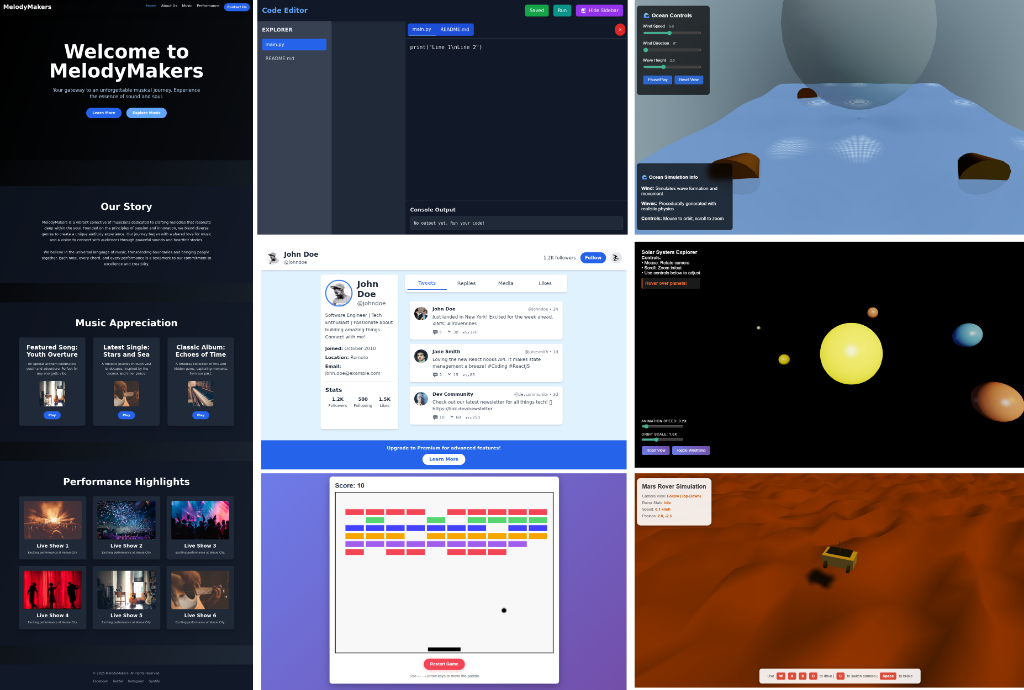
WebUIProof: Benchmarking WebUI Code Generators with UI-Agent Execution Harness
WebUIProof is an execution-oriented benchmark for evaluating WebUI code generation beyond visual appearance or build success. It provides structured UI specifications and dense, executable interaction tests that verify whether generated websites actually behave correctly under user actions, covering both general WebUIs and interactive 3D simulations.
-
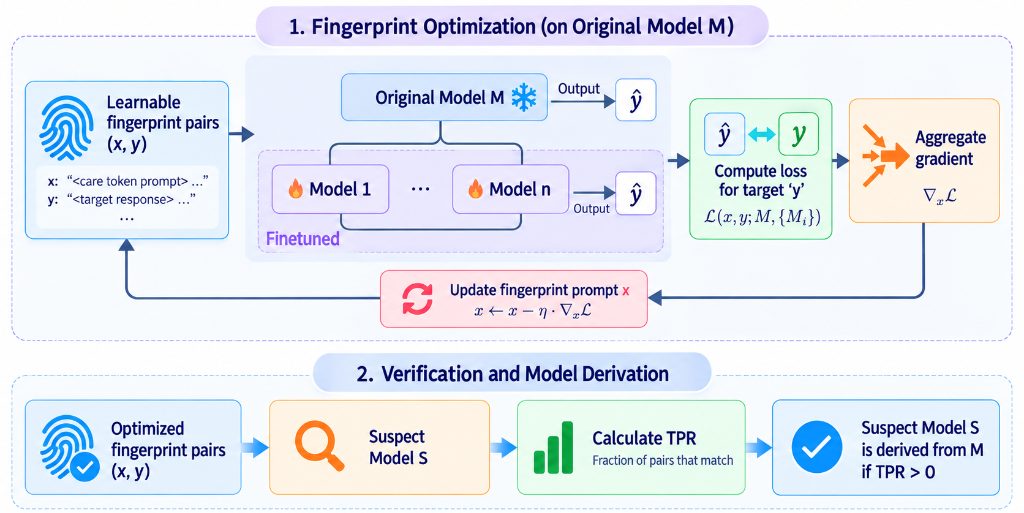
RAFP: Identifying LLM Lineages via Rare-Region Fingerprints
RAFP is a black-box fingerprinting framework for verifying LLM lineage and ownership through carefully optimized prompt–response pairs. It constructs rare, model-specific behavioral fingerprints that remain detectable even after common model modifications such as fine-tuning, LoRA, quantization, system-prompt changes, and different decoding settings, enabling robust post-deployment model provenance verification without access to model weights.
-
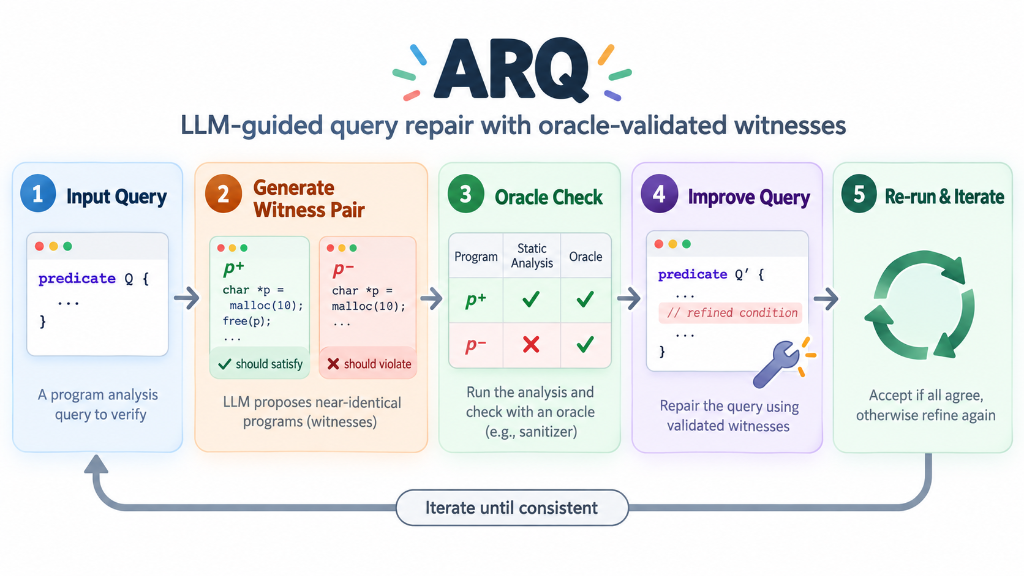
ARQ: Agentic CodeQL Query Refinement for C/C++ Vulnerability Detection
ARQ is an agentic framework that automatically refines C/C++ CodeQL vulnerability-detection queries: it synthesizes near-identical witness programs, checks the query’s verdict against execution oracles to expose false positives and false negatives, and iteratively repairs the query — no labeled data or vulnerability-specific templates needed.
-
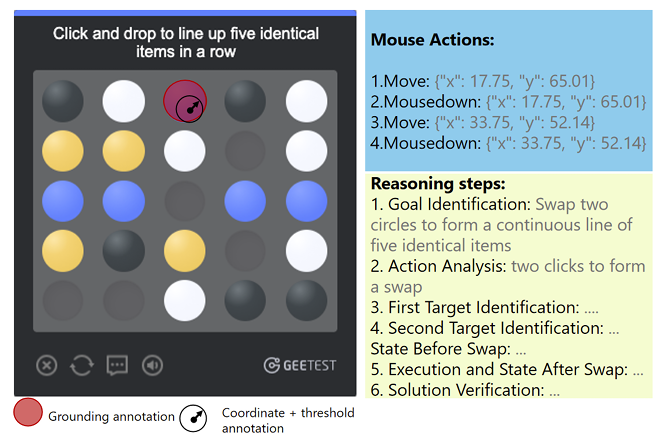
Reasoning under Vision: Understanding Visual-Spatial Cognition in Vision-Language Models for CAPTCHA
We study how vision-language models perform visual-spatial reasoning through CAPTCHA-style tasks. It uses controlled visual challenges to probe whether models can accurately perceive objects, understand spatial relationships, and reason over visual layouts, revealing where current VLMs succeed and where their visual reasoning still breaks down.
-
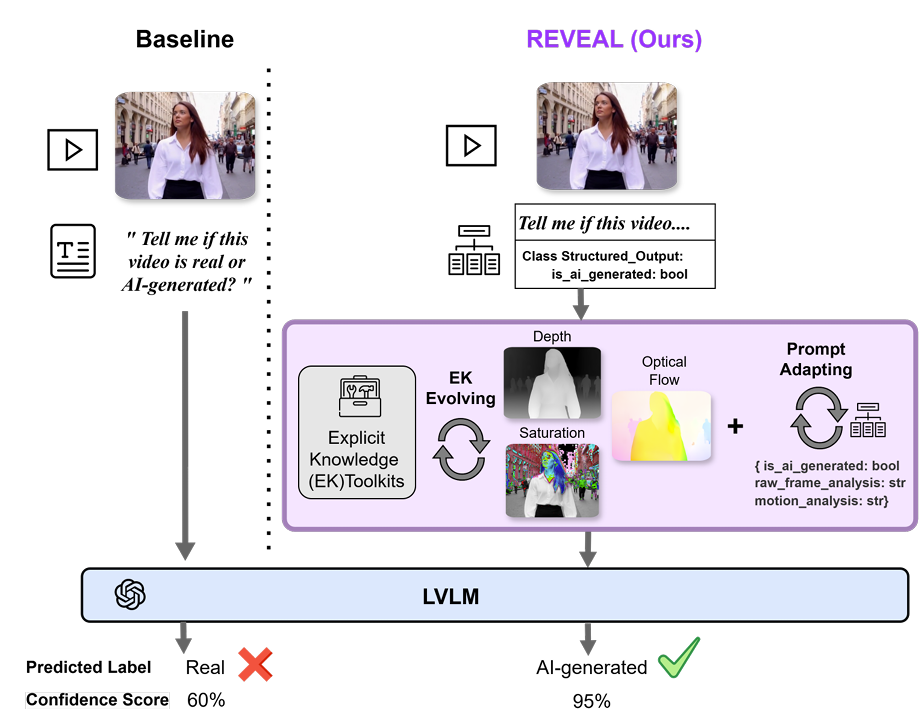
REVEAL: Robust Evolution of Vision-Language Models for Explainable AI-Video Detection
We propose an explainable AI-video detection framework that improves robustness by jointly leveraging visual evidence and vision-language reasoning. It helps distinguish real from AI-generated videos while producing interpretable explanations for its predictions, aiming to make detection more reliable across different generators and manipulation conditions.
-
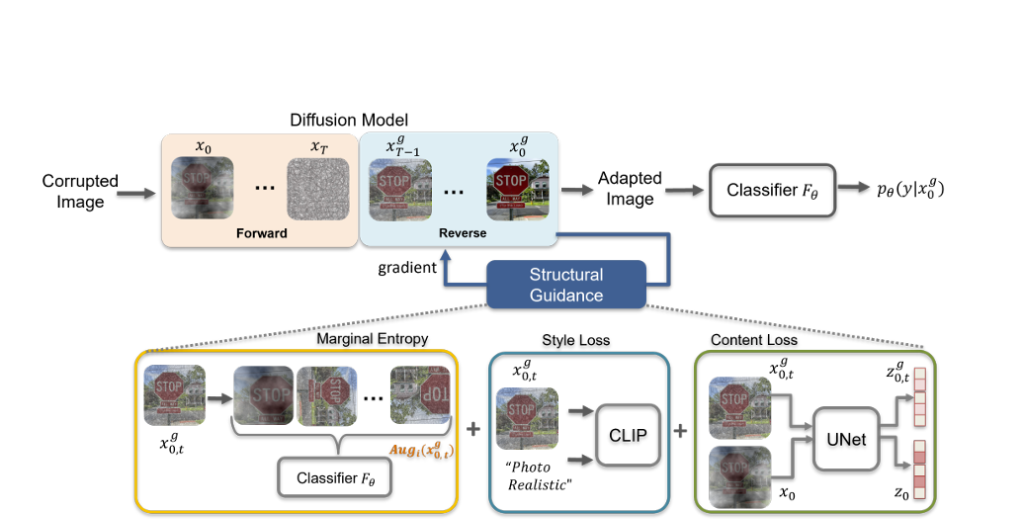
GDA: Generalized Diffusion for Robust Test-time Adaptation
GDA is a diffusion-driven test-time adaptation framework that improves model robustness under distribution shifts without retraining. It uses diffusion-based conditional generation together with entropy, style, and content objectives to adapt inputs at inference time, helping pretrained models recover performance on out-of-distribution data.
-
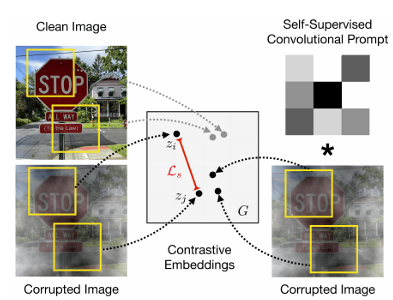
Convolutional Visual Prompt for Robust Visual Perception
We propose CVP, a lightweight test-time adaptation method that learns convolutional input-space prompts to improve model robustness under distribution shift. By modifying visual inputs rather than updating the full model, it enables efficient deployment-time adaptation while preserving the pretrained model and improving performance on out-of-distribution data.
-
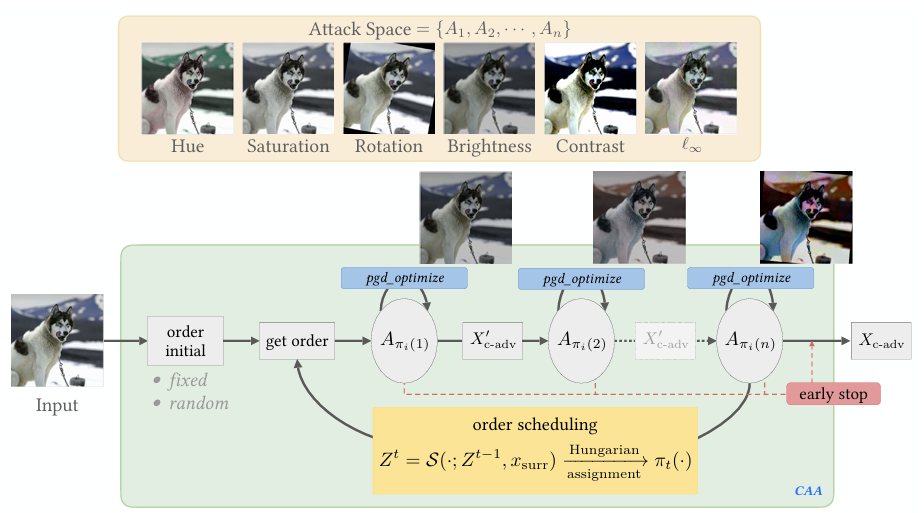
Towards Compositional Adversarial Robustness: Generalizing Adversarial Training to Composite Semantic Perturbations
Towards Compositional Adversarial Robustness extends adversarial training beyond single perturbation types to composite semantic attacks. It trains models to remain robust when multiple meaningful transformations are combined, improving generalization to more realistic and previously unseen adversarial perturbations.
-
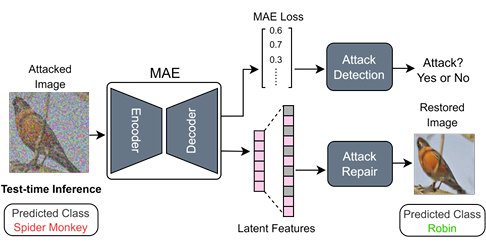
Test-time Defense against Adversarial Attacks: Detection and Reconstruction of Adversarial Examples via Masked Autoencoder
We use a pretrained masked autoencoder (MAE) as a test-time defense: its reconstruction loss flags adversarial inputs at inference, and its latent features repair the image so the classifier predicts correctly — requiring no model retraining.
-
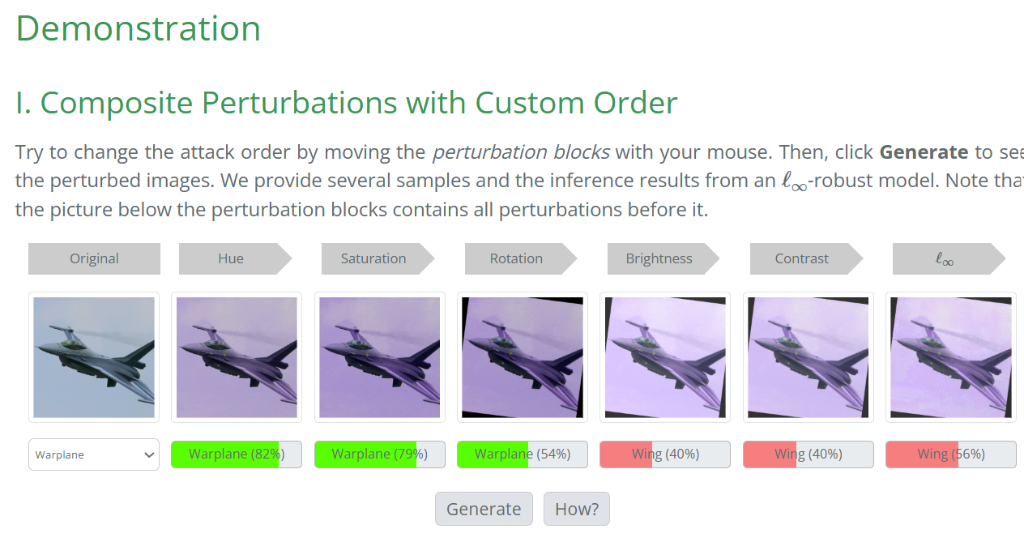
CARBEN: Composite Adversarial Robustness Benchmark
CARBEN is a benchmark of composite adversarial attacks that combine multiple semantic perturbations, for evaluating model robustness beyond standard single-type ℓ∞ attacks.
-
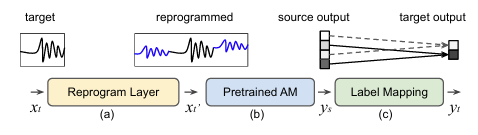
Voice2Series: Reprogramming Acoustic Models for Time Series Classification
Voice2Series reprograms pretrained acoustic models for time-series classification by transforming non-audio time-series signals into representations that speech models can understand. It enables knowledge from large pretrained speech models to transfer to diverse time-series tasks, achieving strong classification performance with limited task-specific training.
-
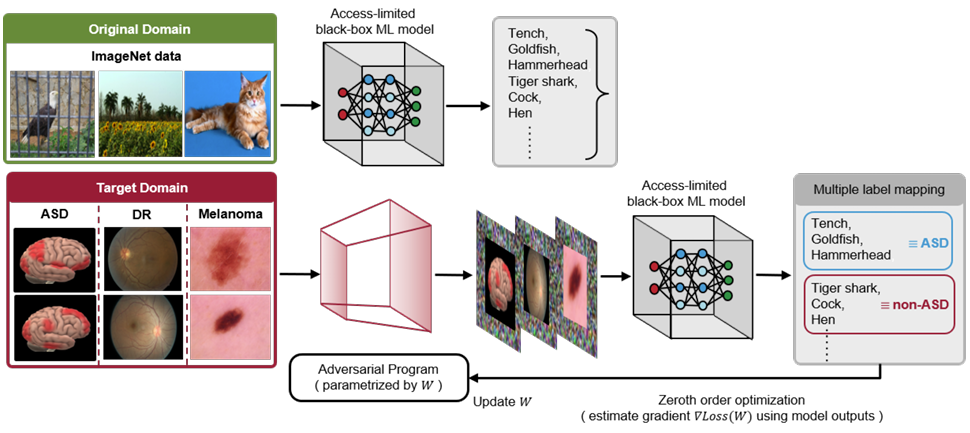
Transfer Learning without Knowing, Reprogramming Black-box Machine Learning Model with Scarce Data and Limited Resources
We introduce a black-box model reprogramming framework that repurposes pretrained machine learning models for new tasks without access to their architecture, parameters, or training data. It learns input/output transformations through model queries, enabling knowledge transfer from inaccessible models to substantially different target tasks.
-
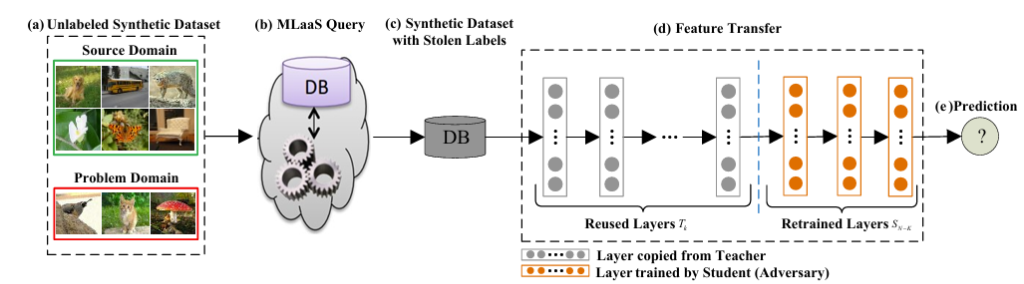
CloudLeak: Large-Scale Deep Learning Models Stealing Through Adversarial Examples
We introduce an efficient black-box model-stealing attack against cloud ML services. It combines adversarial example generation, active learning, and transfer learning to selectively query informative samples near the victim model’s decision boundary, allowing an attacker to train a local substitute model with similar behavior using far fewer queries than prior extraction attacks.
-
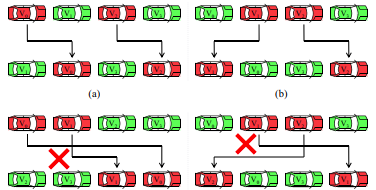
Vehicle Sequence Reordering with Cooperative Adaptive Cruise Control
We study reordering the crossing sequence of connected vehicles with cooperative adaptive cruise control, showing that coordinating the order vehicles pass through intersections can reduce total delay and improve traffic throughput compared with first-come-first-served scheduling.